Wooden Spoon or Silicone Spatula for a Slow Stir?
Choose a wooden spoon or silicone spatula for a slow stir by matching grip, pot shape and movement to the sauce, porridge or stew in front of you.
Your wooden spoon keeps knocking the sides of the saucepan, or the silicone spatula seems to drag rather than stir. For a slow stir, the better choice depends less on a universal rule than on your grip, the shape of the pot and the movement the food needs.
Why does a slow stir feel awkward?
Slow stirring is not one motion. A loose soup may need a broad sweep to keep ingredients moving, while a thick sauce needs patient contact with the base so it does not sit in one spot. The tool should let your hand make that movement without repeated wrist adjustments.
A wooden spoon has a firm, rounded head and a little weight behind it. That solid feel can make it comfortable for stirring steadily through a pot of beans or porridge. A silicone spatula has a flexible edge that can follow the curve of a pan and lift food from the bottom, but it may bend more than you want in a dense mixture.
If you find yourself gripping tightly, stop and notice where the resistance comes from. It may be the food, but it can also be a narrow handle, a head that is too broad for the pot, or an awkward angle against the rim.
Why does the spoon keep catching on the pot?
A broad wooden spoon can feel clumsy in a small saucepan, particularly when the sides rise steeply and the base is narrow. Its rounded head may bump the wall before it reaches the food at the edge. Try a narrower spoon or switch to a spatula with a slim, flexible edge that can trace the curve.
There is also a difference between scraping and stirring. A spoon is suited to moving a mixture through the centre and around the pot. A spatula can make closer contact with the base and corners, which is useful when a sauce coats the pan or a soft mixture settles as it cooks.
Imagine you are gently stirring a small pot of custard with a wide wooden spoon and keep nudging the handle against the rim. If you swap to a narrow silicone spatula, its edge may reach the sides with fewer collisions, making a smooth circuit easier to maintain.
Why does a spatula bend too much?
Flex is helpful when a pan has curved sides, but it can feel vague in a thick mixture. If the blade folds away each time it meets resistance, the handle is not giving you the control you need for that task. A wooden spoon’s rigid head is often more reassuring for slow, steady turns through dense porridge, risotto or a hearty stew.
Check the shape as well as the material. Some silicone spatulas have a broad, soft blade designed to scrape bowls; others have narrower, firmer heads for stirring in a pan. If your spatula bends at the neck, a sturdier model may suit better. If it bends only at the tip, that flexibility may help it follow the pot without forcing your hand to do the work.
For an especially dense mixture, neither tool needs to do every job. A wooden spoon can move the centre, then a spatula can sweep the settled food from the base. Use whichever feels controlled, rather than pressing harder with a tool that is already bending.
What happens when food sticks to the bottom?
Food can catch when the heat is too strong, when the mixture is thick, or when it has been left still for longer than the recipe allows. A utensil can help keep food moving, but it cannot compensate for every cooking condition. Lower the heat if appropriate, then use a spatula to sweep the base in deliberate passes, paying attention to corners and the centre.
In a pot with a flat base and rounded corners, the edge of a silicone spatula can often reach the transition between bottom and side. A wooden spoon may glide over that curve without clearing it closely. In a deep pot of loose soup, by contrast, the spoon’s rounded head can move the liquid comfortably without needing to scrape every surface.
For coated cookware, follow the pan maker’s care guidance about suitable utensils. The same caution applies to the utensil’s heat tolerance and cleaning instructions: check the label or manufacturer’s directions when those details affect your choice.
Which tool suits each kind of movement?
Think about what your hand is being asked to do. A slow circular stir, a scrape along the bottom and a fold through a delicate mixture are different jobs, even if they happen in the same pot.
- For a broad, gentle stir: choose a wooden spoon when a loose soup or stew needs an even sweep through the middle.
- For close contact with the base: choose a silicone spatula when a sauce or thick mixture needs careful scraping.
- For a curved saucepan: try a flexible edge that can follow the side and reach the lower corners.
- For a dense mixture: favour the firmer feel of a wooden spoon if the spatula keeps folding under pressure.
- For delicate folding: use a spatula when lifting and turning is gentler than pushing the mixture around.
Hold each tool as you would while cooking, not just while it is hanging on a shop display. A handle that feels comfortable in a dry hand may feel different when you are keeping the utensil steady at the rim of a warm pot.
How should you choose between a wooden spoon and a silicone spatula?
Can a wooden spoon stir thick sauce?
Yes, if its head can move through the sauce without making your wrist tense. Its rigid shape gives a clear sense of resistance, though it may not scrape a pan’s corners as closely as a flexible edge.
Is a silicone spatula suitable for a slow stir?
Yes, especially when the mixture needs gentle scraping or the pot has curved sides. Choose a blade firm enough for the food, since a very soft head can feel imprecise in a heavy mixture.
Which tool is better for a non-stick pan?
Either may be suitable, depending on the pan maker’s care guidance and the utensil’s condition. Check the manufacturer’s instructions, and avoid using a tool that is damaged or has an edge that could mark the surface.
Should you own both tools?
If you cook varied dishes, both can serve distinct purposes: the spoon for firm stirring and the spatula for close scraping. If you prefer one, choose the tool that handles the movement and pot shape you encounter most often.
What is the simplest way to decide at the hob?
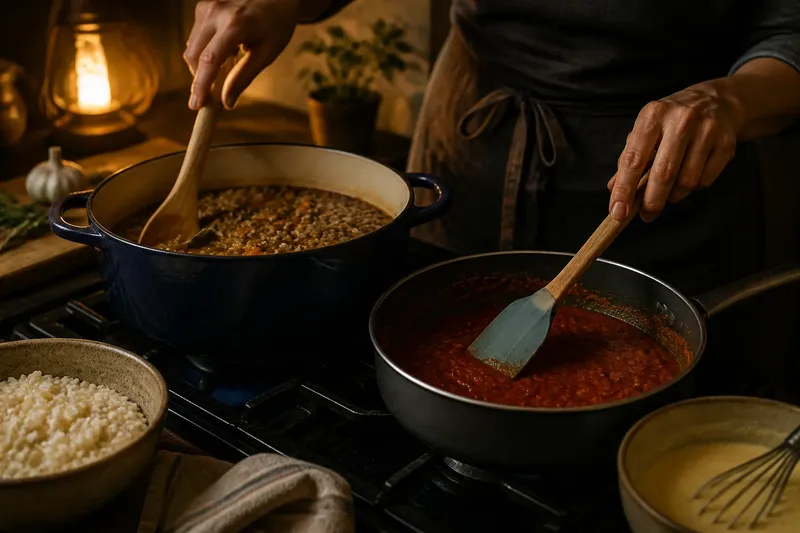
Before you start, look at the pot’s base and sides, then think about the food’s resistance. For a deep pot of loose lentil soup, a wooden spoon may give an easy, broad circuit. For a thick tomato sauce in a shallow pan, a silicone spatula may make it simpler to clear the bottom and sweep the curved edge.
That is the useful distinction in choosing a wooden spoon or silicone spatula for a slow stir: match the tool to the contact you need, not to habit alone. If the movement feels cramped, switch the tool or adjust your grip before you compensate by stirring faster or pushing harder.