How Cooking Instructions Travelled Before Printed Recipes
Before printed recipes became common, cooking instructions travelled through memory, demonstration and household notes. Learn how cooks passed on methods and adapted them.
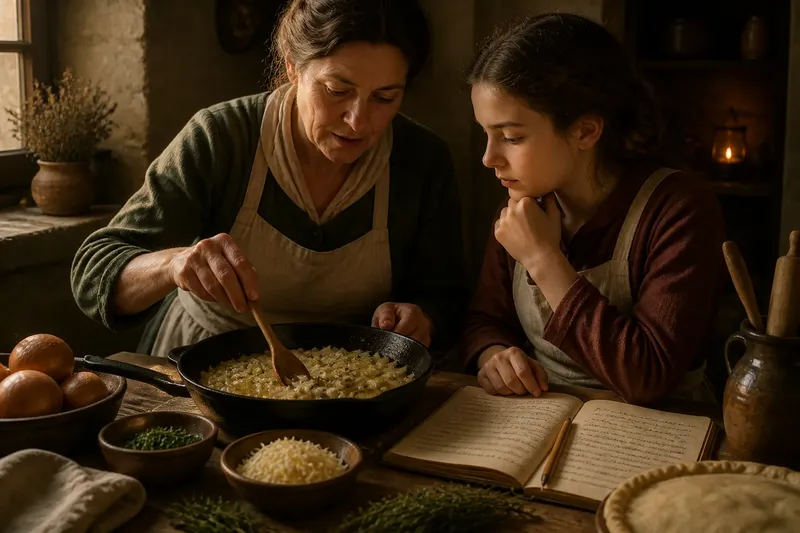
Before printed recipes became common, a cook might learn a pie filling by watching an older relative soften onions, then trying the method at home. Cooking instructions travelled through demonstration, memory and handwritten notes, each carrying a different part of the lesson.
Imagine Aunt Elin teaching her niece Mara to make a savoury pie. This is an invented household, not a claim about a particular family or historical dish. It offers a simple way to see how practical knowledge could pass from one kitchen to another.
What did a cooking lesson teach beyond words?
Elin sets out onions, cheese and herbs but does not dictate quantities. She softens the onions first, adds the herbs, then takes the pan off the heat before stirring in the cheese. Mara watches the change in colour and listens to the pan’s hiss.
“Cook until soft” makes more sense when someone shows what soft looks like. A learner can ask questions as the food cooks; the teacher can point to the pan, correct a movement or explain why the cheese goes in after the heat is off. Timing, sound, sight and conversation all help make a short instruction usable.
What could a learner remember?
After Elin leaves, Mara remembers the order: soften the onions, add herbs, cool the mixture, then stir in the cheese. She is less sure about how much salt to use or how thick to roll the pastry. Memory preserves some details more readily than others.
It also leaves room for judgement. Mara’s onions may be larger, or her pan narrower, than Elin’s. She can use the visible texture of the filling rather than try to reproduce an exact timetable. The lesson is a starting point, not a sealed formula.
Why demonstrate a technique?
When Mara’s pastry tears, Elin presses the gap together and turns the seam underneath the pie. The small gesture is easier to copy than to capture in a sentence. It also shows which details matter: the crust needs to hold its filling, while a perfectly even edge is a matter of preference.
A demonstration has limits, too. Mara has seen one filling made in one pan. If she later works with a wetter mixture, she may need another explanation or a fresh attempt. Watching teaches a method, but it cannot show every variation in advance.
When did household notes help?
Household writing has a long history, but surviving evidence varies by place, period and the kind of record kept. For a specific claim about who wrote cooking instructions or how they used them, it is best to consult a dated manuscript, household book or archive catalogue rather than treat all kitchens as alike.
In our invented scene, Mara writes a brief reminder in a kitchen book: “Cool the onion mixture” and “Keep back pastry for the seam.” The note records the details she is most likely to forget; it does not need to explain skills she can already judge by sight.
A household note can be shorthand for its intended reader rather than a complete recipe for strangers. It might name an ingredient, describe an order of actions or remind the cook of a particular pan. Its meaning depends on what the reader already knows, so a margin note or later amendment can matter as much as the main lines.
How did instructions change as they travelled?
Say Mara later makes the pie with her neighbour Jo, who has cooked beans but no cheese. She keeps the sequence of softening onions, adding herbs and cooling the filling, then uses the beans instead. Jo watches, asks about the cooling, and writes down what she used. The expected result is a different pie with a recognisable method, not a copy of Elin’s dish.
Each cook may retain some parts, change others and add a new explanation. Conversation can clarify why a step matters; a note can help preserve a sequence. Neither channel removes the need to judge what is in the pan.
What do readers ask about cooking instructions before printed recipes?
Did people cook without written recipes?
Some instructions could be learned through watching, listening and practice rather than from a complete written formula. The balance between oral teaching and writing differed across households and periods.
What might a handwritten cooking note contain?
A note could record ingredients or the order of actions, while leaving familiar techniques unstated. Its usefulness depended on who would read it and what that person already knew.
Why might quantities be vague?
A cook writing for personal use could rely on sight, touch and experience instead of specifying every amount. Vague wording might also reflect a method intended to work with available ingredients or equipment.
Did printed recipes replace demonstration?
Printed instructions could circulate beyond a household, but readers still had to interpret descriptions and adapt them to their own kitchens. Demonstration, memory and practice continued to supply details that a page could leave out.
How can you read an old household recipe?
Start with what the page actually says, then separate explicit instructions from your assumptions about them. If an action is unclear, note the uncertainty rather than filling the gap with a confident-sounding detail. A dated source or archive description can help anchor claims about the recipe’s place and period.
Cooking instructions travelled through words, gestures and memory, with household notes sometimes preserving a useful prompt. When you read an old recipe, look for the practical knowledge its first reader may have brought to the page—and remember that the written lines may be only one part of the lesson.